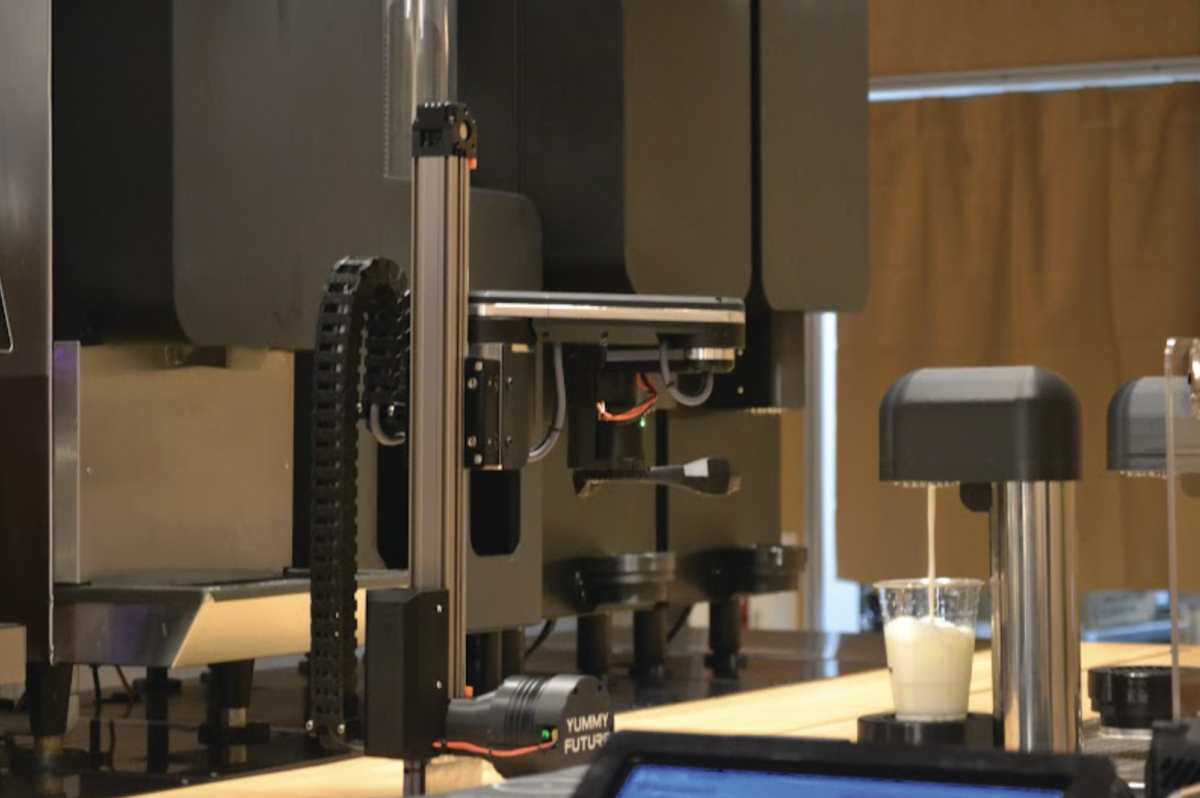
At Yummy Future in downtown Palo Alto, robotic arms shift and twist as they assist the human employees in delivering a perfect cup of latte, from getting ice cubes to transferring the cup across stations.
Yummy Future’s robotic technology optimizes the cafe’s efficiency, quality and food safety by automating repetitive tasks, like scooping syrup and stirring drinks without spilling a drop.
Jack Cui, CEO and co-founder of Yummy Future, said the inspiration for the robot cafe stemmed from greater societal challenges. He believes the company’s approach reflects broader global trends, especially those surrounding workplace sustainability and long-term labor planning.
“I’m looking at the bigger issues we face together as a society,” Cui said. “Labor shortage and an aging population are one of the main challenges we face as our generation, so we are looking at a declining birth rate. You must keep the same level of productivity with the same amount of population, and we have to come up with a productive improvement, so robotics is definitely one of the solutions to do that.”
According to Cui, Yummy Future settled on Palo Alto because of its central location as a hub of high-tech innovation and home to many leading technology companies. He emphasized that the region’s entrepreneurial environment and access to resources made it the ideal place to test and launch their concept.
“We started working on this project last year to open up a shop in Palo Alto because it’s basically the heart of Silicon Valley,” Cui said. “We have been attached to Silicon Valley based on fundraising efforts, and we’ve been receiving all the investment.
Cui said Yummy Future is part of Y Combinator, a three-month program that supports startups and small businesses. The program allowed the team to refine their engineering, business model and long-term deployment strategy.
“We’ve been participating in Y Combinator—it is in the center of innovation, so we have all the ecosystems like the VC ecosystem supporting startups like us to grow,” Cui said.
According to Cui, the robot design has changed what it takes to become a barista. He explained that this shift opens the door for beginners, students and newcomers to participate in café work without years of technical practice.
“The amount of skill required to be a professional barista has decreased by 100 times,” Cui said. “For example, a student can come to the shop, press a button and the drink is ready to be made. It [the robot] has a much better memory than normal humans, and it doesn’t make any mistakes, so there’s no training effort.”
Beyond making the job more accessible to more people, the robot has massively increased Yummy Future’s productivity and efficiency because of how straightforward it is to handle the robot.
“Previously, you had to be mechanically well functioning to be a really good barista—you have to be able to do repetitive work over and over again without any mistakes,” Cui said. “Human-wise, it improves product per worker productivity by four times, and our average is one minute per drink, so in terms of productivity gain, that’s a huge productivity gain.”
Despite the potential of this technology, some setbacks come with such a large-scale project, ranging from building the robot from scratch to optimizing the cafe’s business strategy.
“The biggest challenge is just the grandness of such a big project,” Cui said. “We design the robot, we manufacture it, we program it, we build the operating system for it, we deploy to the shop, we build a shop for it, and then we start to sell to customers. You have to do marketing and fundraising as well, so it entails so many aspects.”
Other than obstacles to creating a startup, the robot itself brings many technical challenges. The team regularly troubleshoots mechanical systems, updates software and refines the automated workflow to prevent small issues from disrupting service.
“What happens is that everything is built from scratch, so you have limited time to test,” Cui said. “The robot keeps failing, so we have designed something like the SpaceX rocket engine system. We call it smart rerouting in the system and it dynamically routes the most efficient locations. We have been facing small mechanical failures, but you have robust redundancy built into the system, allowing you to make mistakes.”
However, Cui is optimistic about robotics becoming more widespread in various industries, beyond the world of coffee. He envisions a future where automated systems support workers across sectors, improving reliability and reducing strain on overstretched labor forces.
“It’s not just in coffee,” Cui said. “I’m a huge bullish person on robotics usage in our world. Basically, it will be incorporated into the restaurant industry. It’s a special machine—it’s like power, it’s like the electricity for us.”