
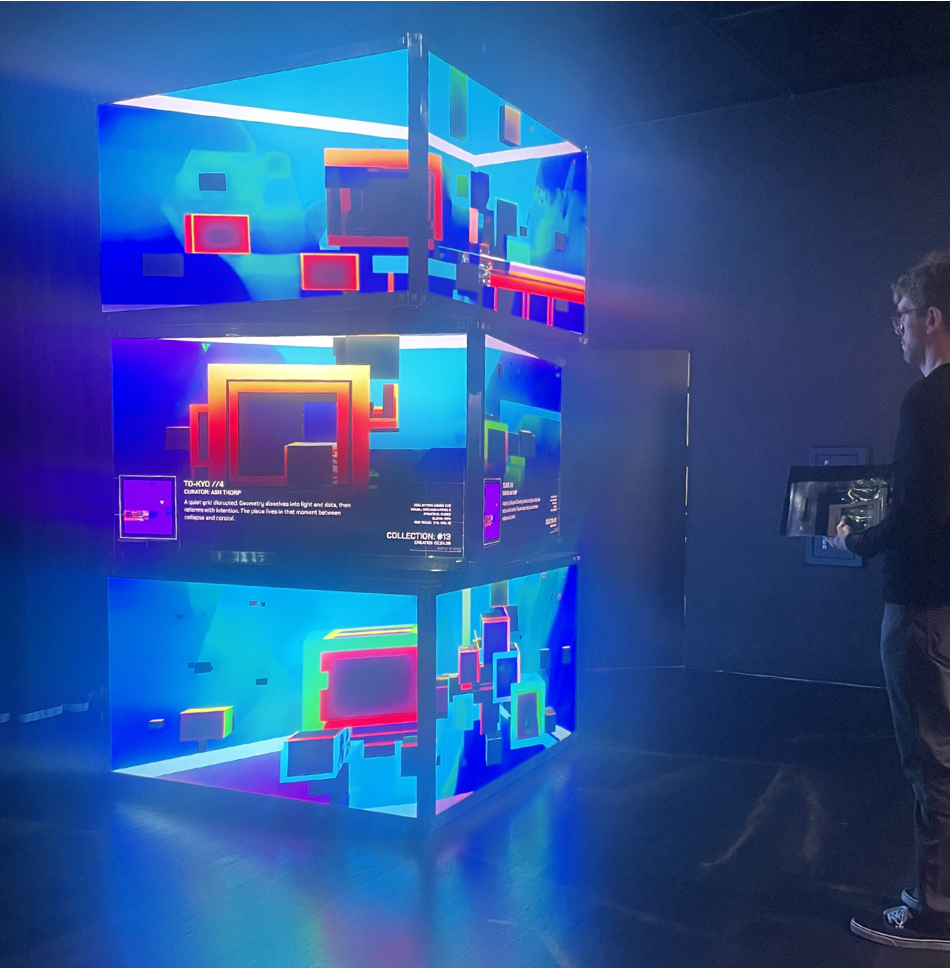
Displayed on a cubic structure built from video screens, a piece reveals an extremely detailed digital landscape composed of generated images that change and evolve in real time.
This piece is part of “Infinite Loop,” the current exhibit on display at NODE on the corner of University Avenue and Emerson Street in downtown Palo Alto.
NODE Foundation is a nonprofit art gallery designed to bring digital pieces into a physical setting. “Infinite Loop” features work by prominent digital artist Mike Winkelmann, more widely known as Beeple.
The exhibit will remain open until June 28, available for free public access Friday through Sunday, and entrance to the gallery is free.
Phil Mohun, executive director of NODE, describes it as a network of people and physical places with the purpose to give digital creativity a physical presence.
“If you try to go to a traditional art place, you get told it’s [digital art] not art, or it’s too expensive to get the screens, or our IT department doesn’t know how to do that,” Mohun said.
NODE opened in January to address these limitations with its opening exhibit “10,000,” which featured CryptoPunks, one of the most well-known non-fungible token collections.
Winkelmann, known for his extensive NFT-based digital art, emphasized the importance of spaces like NODE during a speech at the “Infinite Loop” preview.
“Seeing a place like this that really cares about elevating digital art, giving a voice to this crazy art form that still doesn’t have a huge amount of different outlets is super, super special,” Winkelmann said.
One attendee, Torve Indhal, said that the exhibition connects to his background in deep tech.
“Coming to a digital art gallery gave me a connection between physics, the hidden world of what’s going on with atoms and everything, and it connects me to art,” Indhal said. “So I find it very, very interesting.”
The pieces included in “Infinite Loop” are built using software tools, including newer artificial intelligence models, allowing for the creation of dynamic art.
“Rather than static displays, the entire exhibition is engineered to be an immersive dialogue that transforms passive viewing into an active experience between the audience and technology,” Winkelmann stated in an email.
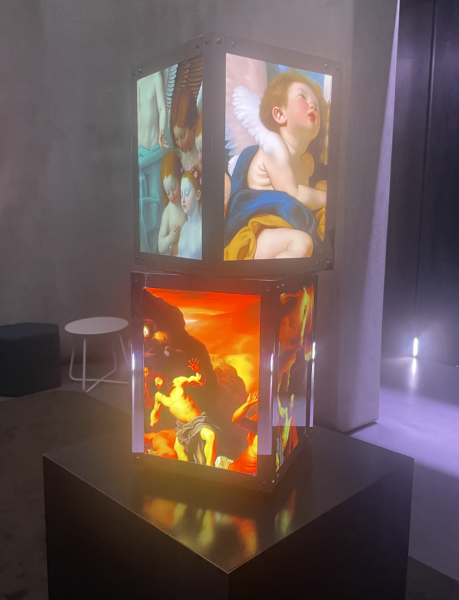
One piece, “Heaven and Hell,” showcases a kinetic sculpture powered by generative AI trained on depictions of “heaven” and “hell” to create a continuously evolving piece. The sculpture sits in a room where the ceiling and walls showcase AI-generated visuals to immerse viewers in the environment.
“The sculpture is an AI model from 2023, and the ceiling and walls are an AI model from this week,” Mohun said. “You can see the difference in how good the tools have gotten.”
Beyond the visuals, a key development is the ability to directly engage with many of the pieces. Either by accessing a custom website or through a kiosk at the gallery itself, the viewer can alter the images being displayed.
In another piece called “Diffuse Control,” curators select images to feed into the system, which uses a diffusion-based AI model to generate its own physical interpretation of the images across a three-layered rotating installation. Because the visuals continuously change, viewers can capture a specific moment of the display, creating a unique print.
“I think that these tools augment creativity,” Mohun said. “They don’t restrict it. They let you do more, basically.”
Looking ahead, Mohun believes that technological tools such as AI will increasingly be integrated into art, whether it’s digital or physical.
“You might use an AI model to help you imagine different versions of the painting before you create it,” Mohun said. “Or if you’re creating a sculpture, you might make a 3D render of the sculpture using tools. So it’s like this computer-aided design is going to become a part of, I think, many people’s practice.”
Winkelmann described the purpose of the exhibition as exploring what digital art is capable of.
“It is fundamentally about proving that digital art is a medium with inherent potential to democratize art,” Winkelmann stated.