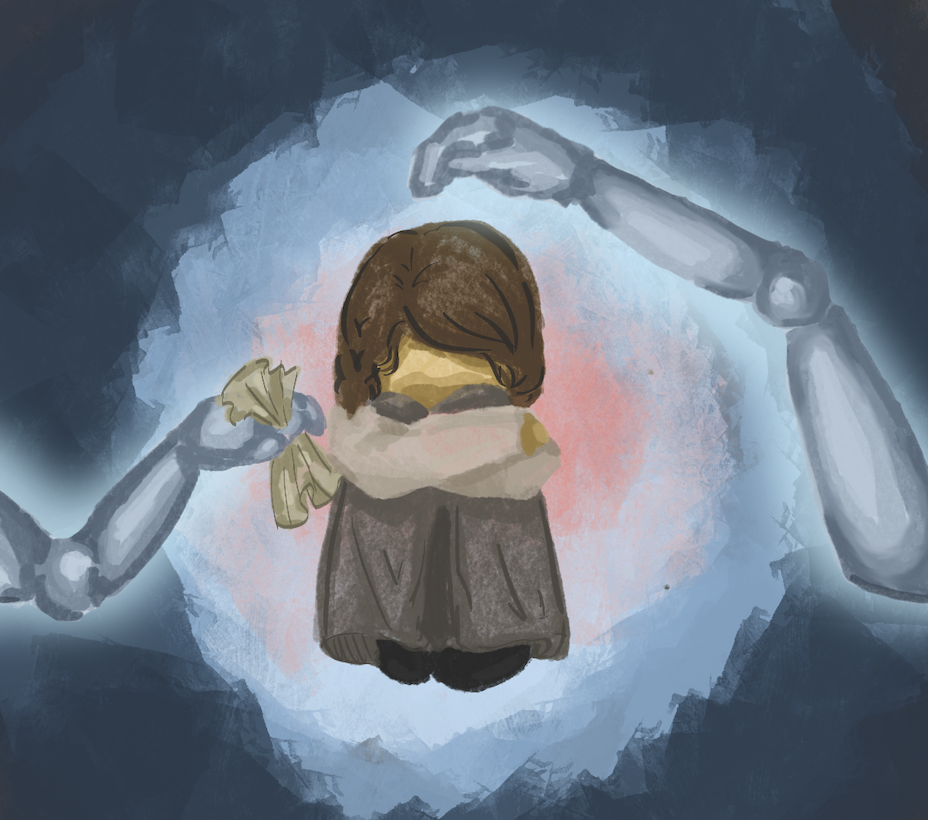
They’ll listen when you need it most, they’ll be accessible to hear your deepest secrets and they’ll remember every detail. Ultimately, they’ll be the hand reaching back out when you can’t find anyone else. But when the text chat stalls and you’re left looking into the black screen, you’re alone again.
Since advanced artificial intelligence chatbots were released to the public in 2022, researchers have raised concerns that the methods these chatbots use to interact with their users foster parasocial dependency, increased loneliness and even potential danger to the user.
The Stanford Institute of Human-Centered Artificial Intelligence says there is a growing trend of people using AI chatbots as therapists for emotional or social support.
According to Ehsan Adeli, a Stanford professor who leads a research group developing AI algorithms related to medicine and mental health, the rising use of AI therapy raises serious concerns about reliability and safety.
“It [AI] lacks full context, personal history, and health records,” Adeli said. “[It] cannot detect nuance in mood, tone, or risk of harm, only based on chat histories. [It] may give generic or misleading advice and reinforce dependency without real-world support systems.”
Additionally, Jared Moore, a Stanford researcher who created a class on the philosophy of AI at the University of Washington School of Computer Science, says that these large language model chatbots lack the nuance necessary to engage in such conversations.
“If we have models that aren’t able to recognize the nuanced nature of suicidal ideation, then it may encourage that kind of behavior,” Moore said. “When we move into unverifiable domains, such as these social and emotional domains … it concerns me that we differ too much to the language model.”
Adeli said these limitations stem from one of AI’s current core principles: to stimulate continued participation.
“[AI is] optimized for engagement, not patient outcomes,” Adeli said. “[There are] no mechanisms to measure or improve mental health results.”
These tools have been especially prevalent among younger generations. Junior Isabella Zheng, president of the Palo Alto High School Clinical Psychology Club, said younger audiences are more susceptible to engaging in potentially unsafe AI use.
“Especially common in the stage of adolescence, AI chatbots’ ability to personify empathy and responsiveness could be very attractive,” Zheng said. “It’s important to be aware that AI lacks real empathy, and is trained on a variety of datasets across the web and internet, … therefore, there remains a possibility that AI will be able to produce harmful outputs sometimes and exacerbate its client’s symptoms.”
Therapy and professional mental health care are generally quite expensive, keeping therapy out of reach for many. AI therapy, however, does not have that same cost barrier. According to Therapy Route, a website that helps people find therapists, the average therapy cost in 2025 is $100 to $288 per session.
Paly computer science teacher Roxanne Lanzot said she finds the shift toward a more human-like AI troubling, especially when users begin to rely on AI for the kind of empathy and understanding that only human relationships can provide.
“What we’re seeking from humans is companionship, friendship, understanding, compassion or advice,” Lanzot said. “The thing that concerns me … is the way that the AI just wants to please you, and almost will say anything to please you or keep you using it, or keep you communicating with it. A good friend or a good therapist, that’s not what they’re about.”
Despite this, Moore said that there are still many reasons why people may turn to AI for social and emotional help.
“They [AI chatbots] are available and they’re accessible, and people may feel shameful about sharing some of the things that they’re experiencing,” Moore said. “Also, you hear about the loneliness epidemic, people not having close companions with whom they could be sharing some of these things. There’s a culture of isolation.”
Moore says that despite being broadly opposed to the broader use of large language model chatbots for therapy, he still recognizes potential use cases in more specialized situations. To Moore, caution is key when it comes to AI therapy.
“Using a language model to simply paraphrase the things that you’re thinking about or feeling … is a more circumscribed use case, one with fewer degrees of freedom, and that seems more appropriate to me,” Moore said. “I worry when we start sharing and trusting the model, we move towards a direction in which we can let it lead the conversation, and so I would just be very cautious about letting it lead.”