Beyond a growing presence in medical technology or computer programs, artificial intelligence has become increasingly present in our schools. According to a study conducted by the Stanford University Human-Centered Intelligence Center in 2026, four out of five U.S. students use AI for schoolwork, but school policies have failed to keep pace.
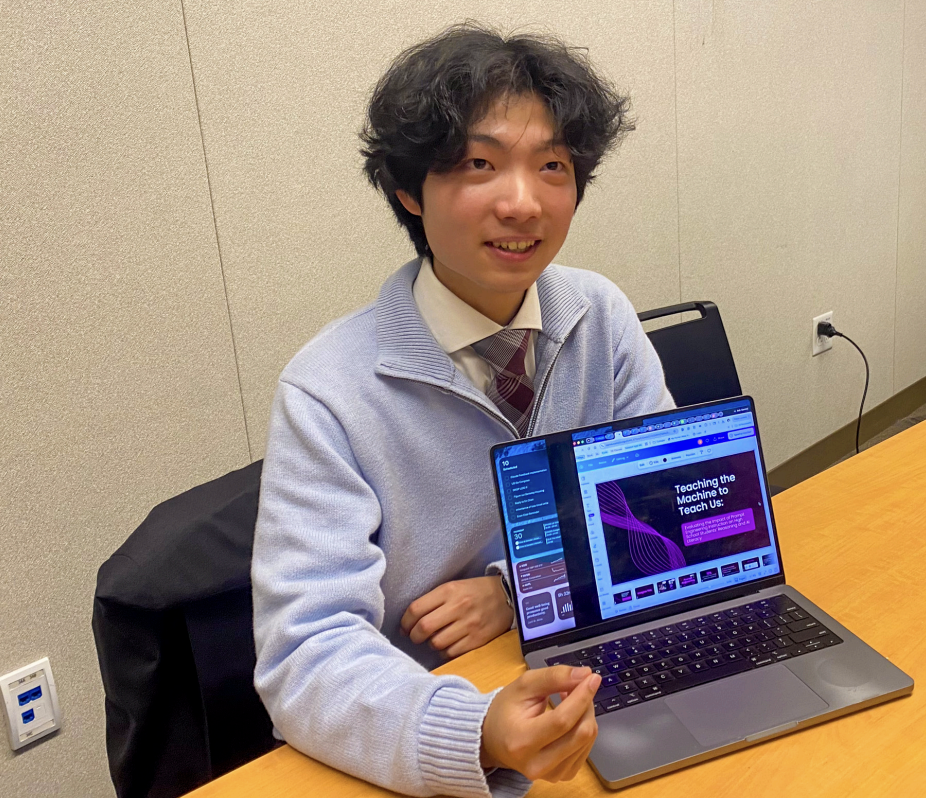
Jerry Yan, a senior in Palo Alto High School’s AP Research program, set out to learn how students are using AI in classrooms.
“I was wondering, with AI being a huge problem in the schools right now, it really raises the question of how do we interact with LLMs [Large Language Model] in the long term?” Yan said.
According to Yan, his initial research found that students’ first instinct is to use AI to replace their own thinking.
“One thing from a literature review that I found very interesting is that substitutive use is the norm,” Yan said. “If you don’t go through any prompt engineering education or AI literacy education, you default to substantive use.”
Yan’s study tested people’s AI use before and after taking an AI literacy course.
According to Yan’s AP Research teacher, Samuel Howles-Banerji, it is important for students to learn how to use AI responsibly.
“If they [students] knew how to use AI to help them learn, as opposed to just giving them answers, it would be a really powerful tool that would be accessible to everyone,” Howles-Banerji said. “I hope that the work that Jerry did can lead towards more development of those [educational] tools and push for those tools to be in front of every student.”
Yan said that he also believes that there is miscommunication about how to effectively use AI that could stem from contradictory messaging.
“Teachers themselves don’t know how to interact with AI,” Yan said. “PAUSD gives us Gemini, but … most of the time, teachers will say, ‘you can’t use AI in this class’.”
However, Yan said his research reveals that AI literacy education can reframe the way students use AI.
“Curriculum in California or even PAUSD at least, should start shifting, whether that be in living skills or English classes, where some AI literacy is taught,” Yan said. “Something that the study has proven as being statistically significant is that if students are put through this 45 minute async curriculum, they tend to have less substantive use and also spot more AI hallucinations, which are always good for education.”
According to Yan, his research does have some limitations due to the size of the study.
“Because we’re in Palo Alto High School and I’m just doing AP research, only 20 people signed up,” Yan said. “Currently, in my entire paper, only 15 people finished their research. As a result, even though my study is a true experimental study, it is not conclusive because of the low statistical power it holds.”
Still, Yan said that AP Research provided him with sufficient resources to start research in the field.
“Overall, it [AP Research] is a good framework that sets a deadline and gives you support whenever it’s necessary, especially if you ask. Mr. HB will be able to provide you with contacts.”
Yan said that his initial findings suggest that AI literacy education could be adopted in the district to reframe the way students use AI.
“For the people who went through the prompt engineering curriculum, they were talking about the process of prompting AI,” Yan said. “The paradigm shifted from ‘the AI could give me results’ versus ‘the AI could help me with the process’